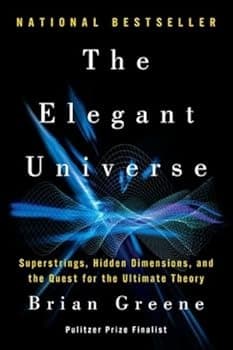
The Elegant Universe
Brian Greene · 1999
PhysicsUnificationScientific Evidence
This book helped me understand why physicists care so much about unification before I understood much of the mathematics behind it. What I kept coming back to was the difference between a theory being mathematically elegant and it being experimentally established. The book made difficult ideas imaginable without making evidence optional.
Reading note
A Small Review of The Elegant Universe
Unification, Scientific Explanation and the Search for Evidence
Brian Greene's The Elegant Universe: Superstrings, Hidden Dimensions, and the Quest for the Ultimate Theory offers a compelling introduction to the effort to explain nature through a unified physical framework. First published in 1999, the book develops its account of string theory by showing why established theories leave important questions unresolved.[1][3] Its strongest achievement is to make the motivation for difficult ideas understandable before asking readers to consider their implications. I find it especially valuable as an example of how scientific explanation can challenge intuition while remaining open to criticism. Its enthusiasm reads best alongside the distinction between what is theoretically possible and what has been experimentally confirmed.
Relativity and the problem of unification
Greene gives the search for unification a clear intellectual purpose. General relativity describes gravity through the geometry of spacetime, while quantum mechanics governs physical behavior at microscopic scales. The challenge is to describe gravity consistently within a quantum framework, particularly where both kinds of effects matter. By explaining the theories before introducing the problem, Greene gives a reader reasons to care about a proposed solution, and makes string theory's features easier to evaluate.
I think that ordering is one of the book's best choices. A reader meeting unfamiliar terminology without that preparation could mistake complexity for depth. Greene instead sets up a question that later ideas can be judged against. His explanations also encourage respect for the achievements of existing theories: an unresolved problem does not erase their success within the settings where they have been tested. The account makes scientific progress intelligible as an effort to extend understanding while preserving what earlier work explains.
Strings and the language of explanation
The book's central proposal replaces pointlike fundamental particles with tiny strings whose different vibrational modes correspond to different particle properties. Greene's comparison with musical instruments makes the proposed relationship memorable: one underlying kind of object can support several patterns. In an authorized adaptation of the book, he compares these patterns with the resonances of a violin or piano string.[2] The image helps the reader understand why string theory promises unification, since apparent differences between particles might emerge from a shared structure.
The analogy works because it explains a relationship rather than merely supplying an attractive picture. It gives a reader a way to organize unfamiliar information. But the comparison needs care. Fundamental strings are theoretical quantum objects; imagining an ordinary vibrating string does not provide a mathematical derivation or establish that such objects exist in nature. Greene's accessible language is a starting point, not the argument itself, and I would keep asking how the underlying calculations justify the image.
Hidden dimensions and the limits of intuition
Greene's garden hose analogy does the most work in his treatment of additional spatial dimensions. From far away, a hose can appear to be a line; an ant on its surface can also move around its circumference. The comparison illustrates how a direction available at a small scale could escape a description made at a much larger scale.[1] This makes the idea of compact dimensions approachable without requiring readers to visualize an entire higher dimensional universe.
What interests me most is the way this example tests the authority of ordinary perception. Familiar experience gives us useful expectations, but those expectations reflect the scales at which we usually observe things. The hose provides a reason to consider a possibility that initially sounds implausible. It cannot demonstrate that extra dimensions exist, and that limit is what makes it useful: it widens the range of ideas I can take seriously while leaving the physical claim to evidence.
Mathematical elegance and experimental evidence
The title draws attention to elegance, which Greene connects with explaining many phenomena through a small set of powerful ideas. In a NOVA interview, he also states that experimental results are necessary to establish whether string theory describes nature.[4] Those two commitments pull against each other. A theory's mathematical structure can make it worth investigating, but the satisfaction of seeing several ideas fit together is different from knowing that their fit corresponds to the physical world.
Greene's 2024 retrospective makes this distinction especially clear. He discusses the absence of the hoped for supersymmetric partner particles at the Large Hadron Collider and explains why that outcome does not, by itself, rule out string theory: the proposed particles could lie beyond the collider's reach. He also acknowledges the difficulty of obtaining specific, unambiguous predictions that current technology can test.[5] This later perspective helps qualify the earlier book's optimism. I read that optimism as an invitation to investigate, with the strength of any claim still set by the evidence available. A disappointing search result can challenge particular expectations without settling every version of a broader theoretical framework.
The ambition of a theory of everything
The phrase "theory of everything" can suggest that discovering fundamental laws would answer every meaningful question, but Greene takes a more careful position. In the authorized book adaptation he explains that a fundamental theory would not make fields such as biology or psychology complete.[2] That qualification is the part I keep coming back to: a description of basic constituents and their interactions leaves enormous work in understanding how complex systems behave.
Knowing the rules that govern components does not automatically make the behavior of a whole system easy to calculate or explain, and questions can stay productive at several levels of description. That is why Greene's ambition is convincing when it supplies a foundation for further inquiry. The book becomes less persuasive if its search for unification is read as a promise of effortless answers. Its accessible presentation also has a practical limit: readers gain a conceptual account of advanced physics, while evaluating the detailed arguments requires mathematical study.
References
- Greene, Brian. The Elegant Universe: Superstrings, Hidden Dimensions, and the Quest for the Ultimate Theory. W. W. Norton, 1999.
- Greene, Brian. “A Theory of Everything?” Authorized adaptation of The Elegant Universe. NOVA, PBS, July 2003. Read source
- Greene, Brian. “The Elegant Universe.” Book description on the author’s official website. Read source
- NOVA. “A Conversation with Brian Greene.” Interview, PBS, 2003. Read source
- Greene, Brian. “The Elegant Universe.” Retrospective excerpt, Broadcast, Pioneer Works, 17 September 2024. Read source