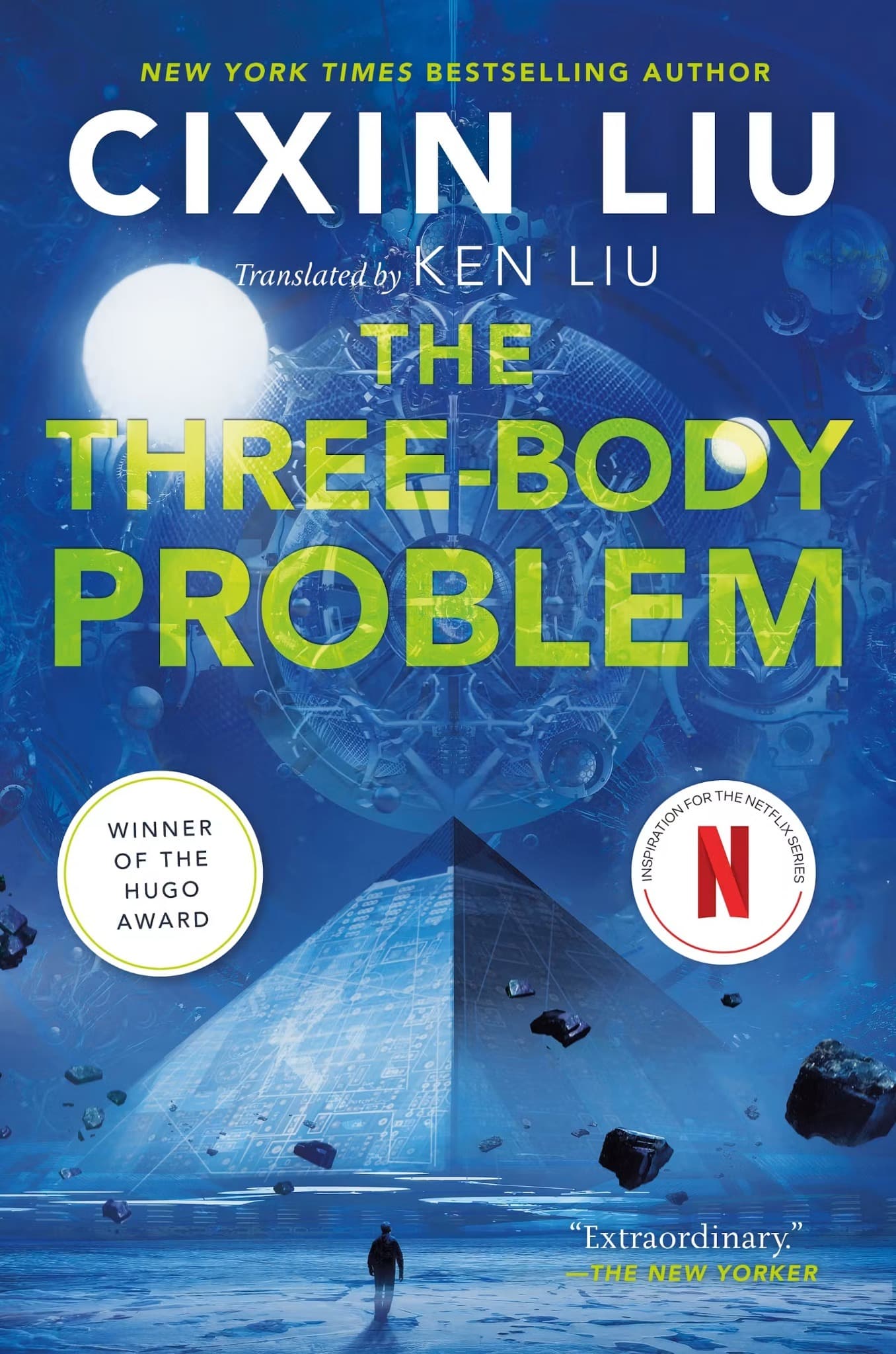
The Three-Body Problem
Liu Cixin · 2014 English edition
PhysicsScience FictionTrust
I liked the way this novel turns scientific uncertainty into a question about human judgment. The three-body problem, the Cultural Revolution, and first contact all become different versions of the same problem: how confident should we be in an explanation, and what happens when someone acts on it before the evidence is complete?
Reading note
A Small Review of The Three-Body Problem
Scientific Imagination, Human Trust and Responsibility
Liu Cixin's The Three-Body Problem connects the violence of China's Cultural Revolution with a speculative encounter between humanity and an alien civilization. Published in English by Tor Books in 2014, in Ken Liu's translation, it is the first volume of a trilogy.[1] Its strongest achievement is to make scientific understanding a source of wonder and vulnerability at the same time. I find the novel compelling because a question about the physical universe becomes inseparable from questions about trust. Knowing more can expand human possibilities, but it cannot ensure that people will use their knowledge wisely or recognize the intentions of others.
History and the freedom of inquiry
The opening gives this concern a concrete form through the persecution of the physicist Ye Zhetai. During a public struggle session, his explanations are judged according to political demands. He asks, "Should philosophy guide experiments, or should experiments guide philosophy?" The question identifies a conflict between an account of nature that must answer to evidence and an authority that requires a predetermined conclusion. The violence surrounding the exchange makes the consequences immediate. A dispute about scientific explanation becomes an attack on the person who refuses to abandon it.
This is an effective scene because it establishes that inquiry depends on social conditions as well as intellectual ability. A correct argument does not protect the person making it when the people listening have the power to punish him for it. The novel therefore begins its cosmic speculation with a failure of human institutions, which makes clear that its concern with science includes the vulnerability of the people who practice it. This gives the later expansion of scale an ethical foundation: the reader has already seen what happens when power makes evidence subordinate to obedience.
Ye Wenjie and the judgment of humanity
Through Ye Wenjie, the book shows how trauma can reshape a person's view of humanity, and then asks whether the actions that follow are justified. She watches her father executed on a stage and sees the destruction of a world she had placed her trust in, which leads her to place that trust in another one. Her relationship to the possibility of contact with another civilization emerges from human experience, rather than from an abstract fascination with extraterrestrial life. The novel becomes especially powerful when the reader can understand a character's despair while questioning the authority that character claims over lives beyond her own.
The game and the search for explanation
The virtual reality game encountered by the scientist Wang Miao gives the search for understanding a striking narrative form. In the King Wen episode, ordinary assumptions about sunrise fail in a world divided into Stable and Chaotic Eras. A proposed calendar looks persuasive at first, and then its promise of extended stability collapses.[3] The episode dramatizes the difference between finding a pattern and establishing a reliable explanation in a scientific way. A successful sequence of predictions encourages confidence, yet the next failure exposes how much remains misunderstood.
The physical problem behind the title concerns three bodies interacting through gravity. Chaotic behavior makes some outcomes difficult to predict, but the problem can still be studied through numerical integration and statistical approaches.[4] This qualification helps clarify what is valuable in Liu's imaginative use of it. The game turns uncertainty into a condition under which people must build a civilization. I find it memorable because the demand for explanation has practical stakes: an apparent improvement in understanding can encourage decisions whose consequences become disastrous when that understanding proves inadequate.
Scientific imagination and cultural interpretation
In his Nature interview, Liu distinguishes science from the speculative details of science fiction: scientific ideas are the starting point, and imaginative projection turns them into stories.[2] That is a useful standard for reading the novel, because its technologies and alien conditions can invite scientific questions without supplying scientific evidence. Its achievement depends on the situations it invents around that problem, rather than on a claim that every invention could be built or every imagined outcome must occur.
In a USC interview, Ken Liu describes cultural assumptions as one of the hardest parts of translation, and explains the limits of footnotes and glosses.[5] That made me more attentive to what might need further context in the opening chapters. An unfamiliar setting should prompt questions about history and language, rather than an assumption that one dramatic scene represents a whole culture. The translation creates an opportunity to encounter another literary perspective while recognizing the limits of the reader's own background.
Strengths and limitations of the narrative
The novel's principal strength is the scale of its connections. A scientist's persecution, a disturbing game, and the possibility of alien contact become parts of one inquiry into knowledge and survival. The movement between these settings sustains curiosity, because the reader has to reconsider what each discovery means. The characters' intellectual ambition drives much of that, and it also shapes how they are written. The book reads as though it began with a speculative idea, with characters developed to serve it, which would explain why its conceptual structure can feel more prominent than the ordinary texture of some characters' lives.
The tradeoff is that explanation can sometimes interrupt emotional momentum. For example, Ye Wenjie's history has particular force, while other parts invite more interest in an idea than in the person presenting it. Even so, the novel rewards patient engagement with its changing scale, and its imagined dangers still need to remain open to examination. Liu describes science fiction, in an NYU Shanghai conversation, as an exploration of possibilities rather than a reliable prediction of the future.[6] The story's account of mistrust is provocative without establishing that every encounter between civilizations would follow its logic.
Questions for further study
The question I would pursue further is how limits on prediction should affect confidence in a model. One useful extension would be to compare simulations of gravitational motion with slightly different starting conditions, while checking that apparent differences do not merely reflect numerical error. The literary question is related but distinct: when a character believes that humanity or an unfamiliar civilization will behave in a particular way, what evidence supports that expectation? The novel makes both questions consequential, asking the reader to notice the distance between a convincing explanation and a warranted decision.
The Three-Body Problem earns a strongly favorable review because it gives scientific speculation a human history and a moral cost. Its most compelling passages connect the desire to understand with the difficulty of deciding whom to trust. I would recommend it to readers interested in physics and fiction that challenges the scale of their thinking. Its imaginative reach is most valuable when accompanied by careful judgment about where an explanation ends, where speculation begins, and who bears the consequences of acting on either.
References
- Liu, Cixin. The Three-Body Problem. Translated by Ken Liu. Tor Books, 2014. Publisher description and authorized excerpt from “The Madness Years.” Read source
- Grassmann, Preston. “The Three-Body Problem and Beyond — A Q&A with Liu Cixin.” Nature Blogs, 19 August 2016. Chinese translation by Ken Liu. Read source
- Liu, Cixin. “The Three-Body Problem: King Wen of Zhou and the Long Night.” Translated by Ken Liu. Authorized excerpt, Tor.com, now Reactor, 16 September 2014. Read source
- Stone, Nicholas C., and Nathan W. C. Leigh. “A Statistical Solution to the Chaotic, Non-Hierarchical Three-Body Problem.” arXiv:1909.05272, 2019. Read source
- Wang, Catherine. “Q&A with Ken Liu, Translator of The Three-Body Problem.” US-China Today, USC US-China Institute, 11 September 2015. Read source
- NYU Shanghai. “Liu Cixin Demystifies Sci-Fi Writing.” 14 September 2018. Excerpt from Sheldon Brown’s interview with Liu Cixin. Read source